
Swan lagoon
a study of power against softness
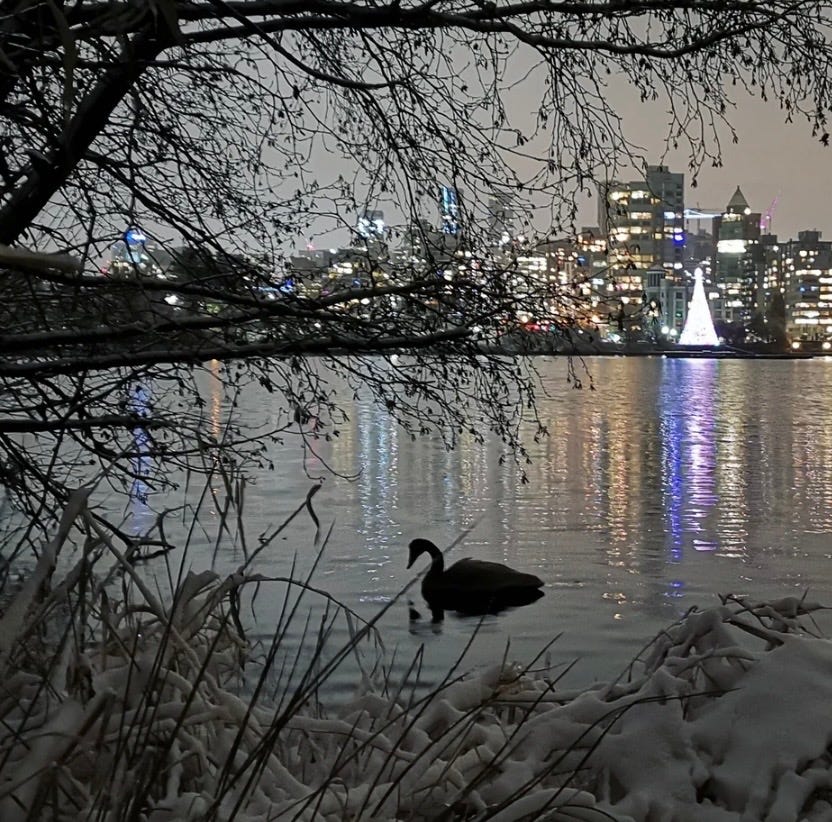
Dawn rose shrugging off a blanket of mist; a thin thought waking but not yet spoken. The swan moved through the lagoon with ease, the only sign of effort was the ripple slowly fading into the blue stillness.
By noon, the sun had grown high, and the artist sought refuge in the air-conditioned museum. A pamphlet found its way into their hands, and soon they were drifting along with a tour group. The first thing the artist noticed in the sculpture was the hand.
The guide lifts her own to demonstrate. See how the fingers embrace the white marble thigh. See how the stone yields as if it were flesh from a living breathing being.
“A visionary of Rome”, she says. The sculptor was a genius, ahead of his time, no one understood softness like he did.
The group gathers in a crescent of admiration.
The artist lingers at the edge drawing closer to the sculpture as if pulled in a trance. Up close, the swan’s wings rises over the woman like a pale canopy, each feather carved with devotional patience. The woman bends inward, one knee lifted, spine curved in a shape that might be mistaken for grace. Her face tilts away from the spotlight, as if an afterthought; her mouth parts just enough to hold a suspended breath.
For weeks the artist has been waking before light to watch a pair of Trumpeter swans gliding across the blue. They arrive through grey mist without spectacle, white bodies gathering in the thin yellow of morning. On the water they seem architectural, their necks form deliberate arcs, their reflections double them into symmetry so clean it feels arranged.
Grace is easy to believe at a distance.
Up close, their size alters the air; wings wide enough to cast shadows across reeds. When one opens its wings fully, the movement is not ornamental but declarative. Once, a smaller duck drifted too near to its nesting site. The swan lunged without hesitation, neck extended, wings half-raised. The duck fled in a flurry of feathers, the only sign of its presence was a brown feather left on the bank.
Another morning, a lone Canadian goose ventured into the shallows. The swan advanced without hesitation. There was no myth in it, no grace or illusion, only the law of survival; the territorial blunt action of a larger body defending it’s nest.
Bodies are bodies before they are symbols.
Here, in marble, the swan wing of the Greek God looks almost protective.
The guide speaks of transformation. The Greek God Zeus clothed in the pure feathers of a white swan; divine desire made visible. Artists have returned to this scene for centuries, she says, because it allows for contrast. Feathers against skin. Power against softness.
Power against softness.
The artist steps closer.
The details of the hand is extraordinary; each finger presses into the marble thigh with careful precision, causing the surface to dimple as if yielding beneath touch. Visitors murmur at the intellectual thought echoing off centuries-old marble. A man leans in to photograph, the indentation as though the entire achievement of the sculptor resided in the marble statue.
The artist looks instead at the woman’s neck.
There is tension there; a tendon sculpted just beneath the surface. The angle might be a mere imperfection, or it could signal ecstasy or recoil. The sculptor left the meaning suspended, polished but never erased.
Why this moment ?
The question moves quietly through the artist’s mind.
The sculptor could have chosen ascent, could have carved the swan lifting skyward, wings opening into air. Instead he fixed them here, at this point of pressure. At the place where contact becomes insistence.
Perhaps he was fascinated by swans, by the engineering of feather and bone, by myth as permission to study flesh without apology. Perhaps he believed he was revealing something about his own society, where women were exchanged in contracts and alliances, their resistance smoothed into ritual.
Or perhaps it was simply to sculpt what his patrons desired.
The guide’s voice continues, bathing the sculpture in admiration. “Genius must be understood within his time because you see innovation requires daring.”
The group begins to drift toward the next exhibit, and as their murmured admiration dissolves into the museum’s quiet, the alcove falls still.
The wing no longer shelters, it encloses. The woman’s bent knee reads less like dance and more like imbalance. The brilliance of the hand does not dissolve its placement.
The artist opens the sketchbook.
This time the drawing is not marble but morning. A trumpeter swan mid-strike, wings extended in unmistakable force. The neck straightened, no longer a decorative curve but a line of intention.
No divinity. Just muscle and breath, the authority of a body that knows its own size.
Outside the museum, the water opens beneath a low sky. A trumpeter swan drifts near the bank, white but not immaculate, its body gliding low over it’s territory. When it lands, the lagoon’s crystal blue fractures, then settles quietly back into place.